
Urgency can feel productive in the moment. It creates motion, energy, and a sense that we are doing something important. When the inbox is full, the calendar is packed, and the problems keep coming, moving quickly can feel like leadership.
And sometimes, if we are honest, urgency gets rewarded. People appreciate the fast response, the quick fix, the leader who jumps in, the person who saves the day. That appreciation can feel good. It can make us feel useful, needed, and effective.
But it is worth asking: Are we being affirmed for the kind of leadership that actually sustains the work, or simply for our willingness to absorb everyone else’s urgency?
Over time, constant urgency does something dangerous to leadership teams: it trains us to react instead of think. And when leaders are always reacting, we can begin to confuse movement with progress.
We can also begin organizing our days around everyone else’s agenda instead of the work we said mattered most. We answer the message, take the meeting, solve the problem, fill the gap, and respond to the loudest need in front of us. None of those things are wrong on their own. In fact, many of them are part of leadership.
But when responding becomes our primary rhythm, we risk building a leadership life around reaction instead of intention.
I have seen this in schools, organizations, and leadership teams of all kinds. The pace keeps increasing. The calendar keeps filling. Decisions stack up. Messages come in from every direction. Everyone is working hard, but very few people have the space to pause and ask, “Is this actually the right work?”
I get caught in this myself, more than I care to admit.
At times, it feels much better in the moment to sweep in like Superwoman and save the day. Solve the problem. Answer the question. Take something off someone else’s plate. Be helpful. Be responsive. Be the leader people can count on.
But when I do that too much, or too often, I usually go home exhausted — and still needing to do the work that only I can do.
That is one of the hidden costs of urgency culture. It does not just fill our days. It can pull us away from our priorities, our purpose, and the deeper work of leadership.
The cost shows up slowly. It shows up when meetings become updates instead of meaningful conversations. It shows up when leaders stop bringing creative ideas because there is no room to explore them. It shows up when people hesitate to name concerns because everyone already feels stretched. It shows up when the same problems keep returning because the team never had time to address the root cause.
And for many leaders, it shows up when they begin to measure their value by how much they can carry instead of how clearly they can lead.
That is not sustainable leadership. That is endurance disguised as effectiveness.
One of the most important responsibilities of a leader is to help a team distinguish between what is truly urgent and what is simply loud. Not everything that demands attention deserves immediate attention. Not every problem requires the whole team. Not every request needs to become a meeting. Not every decision should be made at the speed of someone else’s anxiety.
Slow Leadership asks us to pause long enough to lead with clarity. That pause does not make us weak. It makes us wise. It gives us enough space to ask better questions:
- What actually needs our attention right now?
- What can wait?
- What have we allowed to become urgent because we failed to plan for it earlier?
- What pattern keeps creating this pressure?
- Who is paying the price for our pace?
Leadership teams do not become more effective by constantly speeding up. They become more effective by learning when to slow down, clarify, prioritize, and act with intention.
Here are five ways to begin shifting the culture.
1. Name what is truly urgent.
Before responding to the next demand, pause and ask: Does this require immediate action, or does it simply feel uncomfortable to leave unanswered?
That question matters because discomfort often disguises itself as urgency. Sometimes we rush because we do not want tension to sit. Sometimes we respond quickly because we do not want someone to be disappointed. Sometimes we move fast because slowing down would require a harder conversation.
Naming what is truly urgent helps a team create breathing room without ignoring what matters.
2. Protect thinking time.
If every open space on the calendar gets filled, leaders lose the ability to lead strategically. White space is not wasted time. It is where reflection, preparation, problem-solving, and better decision-making happen.
A leadership team cannot build a healthier culture if there is no space to notice what is unhealthy. Protecting thinking time is not a luxury. It is part of the work.
This may mean holding time before a major decision, ending meetings with next-step clarity, or creating space in the week where leaders are not simply moving from one conversation to the next.
3. Stop rewarding crisis behavior.
Sometimes we unintentionally celebrate the person who is always available, always answering, always sacrificing, and always stepping in. We praise the person who carries the most without realizing we may be reinforcing a culture where depletion becomes the price of being valued.
That does not mean we stop appreciating hard work. It means we become more careful about what we recognize.
Instead of only praising speed and sacrifice, we can also recognize clarity, preparation, boundaries, thoughtful decision-making, and the leader who helps prevent the same crisis from happening again.
4. Look for the pattern behind the pressure.
A single urgent issue may need a quick response. Repeated urgency is usually a signal.
If the same type of pressure keeps showing up, the issue may not be the people. It may be the system. Repeated urgency can reveal unclear communication, lack of planning, weak boundaries, delayed decisions, or expectations that were never clearly named.
Slow Leadership does not just ask, “How do we fix this right now?” It also asks, “Why does this keep happening?”
That second question is where culture begins to shift.
5. Give your team permission to pause.
A simple leadership phrase can change the tone of a room:
“We do not need to solve this in the next five minutes. Let’s make sure we are solving the right problem.”
That kind of pause can prevent rushed decisions, unnecessary conflict, and avoidable rework. It also communicates something important to the team: we are not going to let pressure make all of our decisions for us.
The goal is not to eliminate urgency. That would not be realistic, and honestly, it would not be leadership.
There will always be moments that require a quick response, a hard decision, or our full attention. The work we do matters, and sometimes the needs in front of us are real and immediate.
But I am learning that I have to be honest about the difference between responding to what matters and allowing urgency to run my leadership life.
When urgency leads, I feel it. I go home tired in a different kind of way. My mind keeps spinning. I have given pieces of myself away all day, but I am not always sure I gave my best energy to the work that mattered most.
And I see it in teams, too. People stop thinking creatively. They become more guarded. They move from one thing to the next, but they lose the space to shape the work with clarity and purpose.
That is why Slow Leadership matters to me.
It is not about doing less because the work matters less. It is about moving with more intention because the work matters so much.
It is about creating enough space to ask better questions, make better decisions, and lead in a way that people can actually sustain.
Because when urgency leads, we survive the work.
But when clarity leads, we can breathe, think, contribute, and stay connected to the purpose that brought us to the work in the first place.
Here if you need anything-
Dr. Cabeen
Want more?
If this resonated with you, remember: sustainable leadership isn’t built through dramatic change. It’s built through intentional choices repeated over time.
→ Master Your Schedule
Align your time with what matters most and create a calendar that supports your priorities, not just your obligations.
→ Principal in Balance
Practical strategies for leading well at work and living well beyond it.
→ Speaking, Workshops & Coaching
Support for leaders and teams ready to move from hustle culture to sustainable impact.
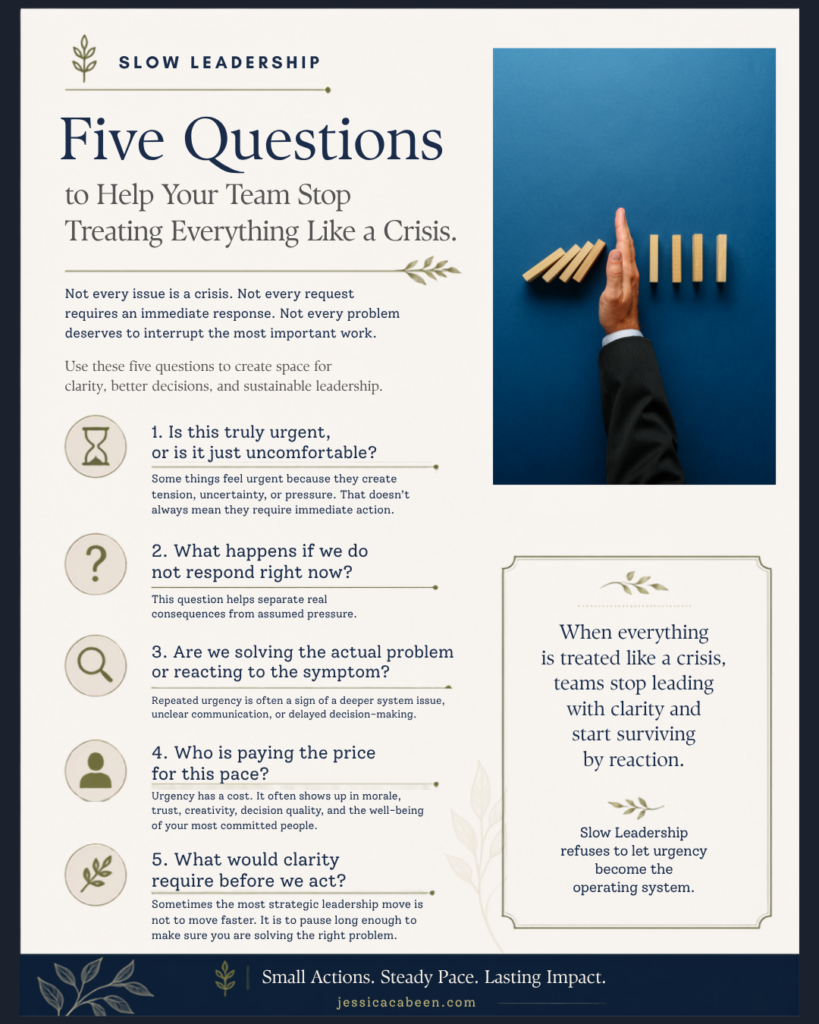
Check out this resource: 5 Questions to Help Your Team Stop Treating Everything Like a Crisis
0 Comments