
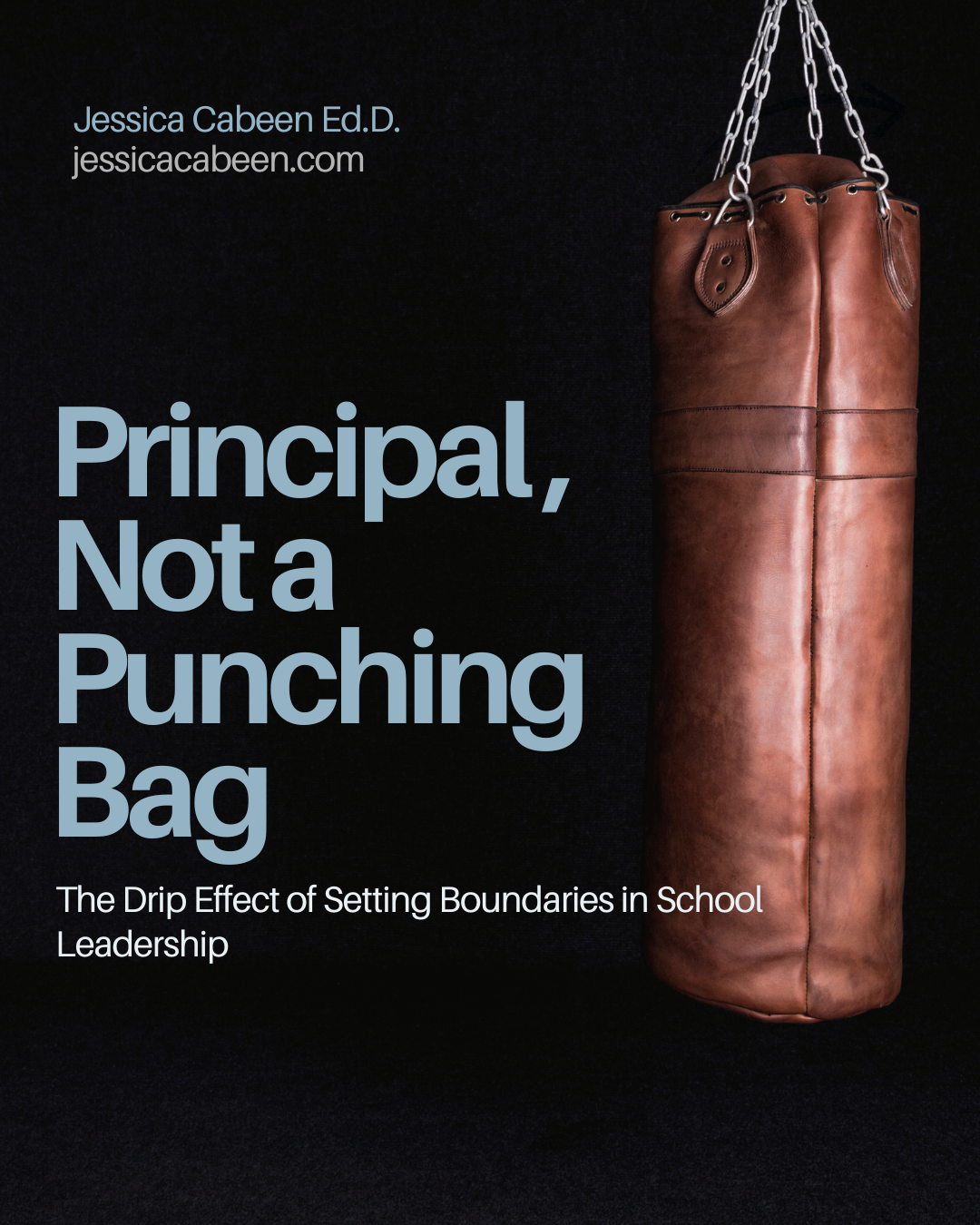
The Drip Effect of Setting Boundaries in School Leadership
Asking for a friend…
Have you ever allowed someone—a parent, colleague, or even someone you supervise—to speak to you in a way you would NEVER allow if you were observing that same interaction happening to someone else?
Maybe it was a raised voice during a meeting. An email filled with personal attacks. Or a conversation where you found yourself absorbing words you would immediately interrupt if they were directed at one of your teachers.
And yet, because you’re the principal, you take it.
You listen. You nod. You try to de-escalate. You remind yourself that everyone is carrying something, and handling difficult situations is part of leadership.
But when did being a leader start meaning being a punching bag?
When Serving Others Comes at Your Own Expense
While working on The Drip Effect, Jimmy Casas and I explored four leadership archetypes: the Reactor, Striver, Controller, and Dreamer.
One pattern worth examining is how Strivers can struggle with boundaries.
Strivers keep showing up, working hard, and finding ways to make things better. But sometimes that commitment comes at a cost.
I’ll admit, I have a bad habit of volunteering to be the “bad cop” in difficult conversations.
If we’re meeting with a family or a tough message needs to be delivered, I’m often the first to raise my hand. My thinking? Let me handle the uncomfortable part so someone else can preserve the relationship.
And while my intentions are good, this has backfired more than once.
Not because I necessarily delivered the message poorly, but because I wasn’t always the right person to deliver it. I was simply the person willing to do it so someone else didn’t have to.
And when we repeatedly volunteer to absorb conflict, we can unintentionally become the person everyone expects to take the hit.
Just because you’re willing to carry the hard conversation doesn’t mean it’s yours to carry.
Boundaries Are Not Barriers
Let’s be clear. Parents have every right to advocate for their children. Staff deserve opportunities to challenge decisions and disagree with leadership. Sometimes those conversations will be emotional.
But there’s a difference between expressing frustration and directing personal attacks, intimidation, or harassment toward someone.
We can acknowledge feelings without accepting unacceptable behavior. We can listen without becoming a target.
So how do we establish boundaries and maintain them when the punches keep coming?
That’s where the four rhythms of The Drip Effect can help.
Pause: Recognize the Boundary
When someone raises their voice, makes a personal attack, or repeatedly interrupts, our instinct may be to keep the conversation moving.
But pausing gives us an opportunity to ask: Is this conversation productive, or am I continuing because I feel obligated to absorb the behavior?
Sometimes a simple statement is enough:
“I want to understand your concern, but I need us to have this conversation respectfully.”
Pausing isn’t weakness. It’s recognizing that how we communicate matters just as much as what we communicate.
Clarify: Communicate the Boundary
Here’s something I’ve learned: We can’t expect people to respect boundaries we’ve never communicated.
Instead of hoping the behavior changes, we need to name what is and isn’t acceptable.
“I’m willing to continue this conversation, but I won’t continue while I’m being yelled at.”
A boundary isn’t about controlling someone else’s behavior. It’s about being clear about what you will do if that behavior continues.
Clarity isn’t confrontation. Sometimes it’s the most respectful thing we can offer.
Act: Follow Through
This might be the hardest part, especially for Strivers.
Once we’ve established a boundary, we have to maintain it. That might mean ending a meeting, rescheduling with another administrator present, or changing how future communication takes place.
And it might mean accepting that someone will be unhappy with our decision.
That’s okay.
Boundaries without follow-through are simply suggestions.
But there’s another important part of this conversation.
Sometimes what begins as a difficult interaction becomes something much more serious.
Harassment. Threats. Intimidation. Sexual comments or behavior that crosses professional boundaries.
In January 2026, I wrote an article for NASSP’s Principal Leadership magazine, “Confronting Harassment as a School Leader,” sharing my own experience with sexual harassment in educational leadership.
We spend so much time advocating for safe, respectful environments for our students and staff. But what happens when the person experiencing harassment is the principal?
When a difficult conversation crosses the line into harassment or becomes unsafe, it’s no longer just about setting boundaries. It’s about taking action.
Document what happened. Report it through the appropriate channels. Seek support. And if your immediate safety is at risk, prioritize getting to safety.
You don’t have to prove your strength as a leader by enduring mistreatment in silence.
Refine: What Are We Modeling?
After a difficult interaction, I’ve learned to ask myself two questions:
What did I allow that I would have challenged if it happened to someone else?
And was I the right person to have that conversation in the first place?
Because our responses don’t just affect us. They shape the culture of our schools.
When we model respectful disagreement, we demonstrate that conflict can be productive. When we maintain boundaries, we show that accountability and compassion can coexist.
You Can Lead With Grace and Still Have Boundaries
After more than two decades in school leadership, I still believe deeply in being accessible, approachable, and willing to have hard conversations.
I believe in listening first, extending grace, and recognizing that people often bring more into a conversation than we can see.
But leading with grace doesn’t mean giving everyone unlimited permission to treat us however they choose.
You can have an open door without being a doormat.
You can care deeply about people and still say, “That’s not okay.”
You can support your team without volunteering to carry every difficult conversation.
And you can be a principal without being a punching bag.
The Drip Effect reminds us that sustainable leadership is built through small, intentional actions repeated over time. Sometimes that means pausing before responding, clarifying a boundary, or having the courage to follow through.
And sometimes it’s recognizing that the responsibility was never yours to carry in the first place.
Your next drip: Think about a boundary you’ve been hesitant to establish or a difficult conversation you’ve volunteered to carry. If someone on your team were in the same situation, what advice would you give them?
Now ask yourself: Why should the expectation be any different for you?
Small Actions. Steady Pace. Lasting Impact.
0 Comments