
You can say what matters.
Culture.
Relationships.
Instruction.
Strategy.
Well-being.
You can name the priorities clearly.
But here’s the disruptive question:
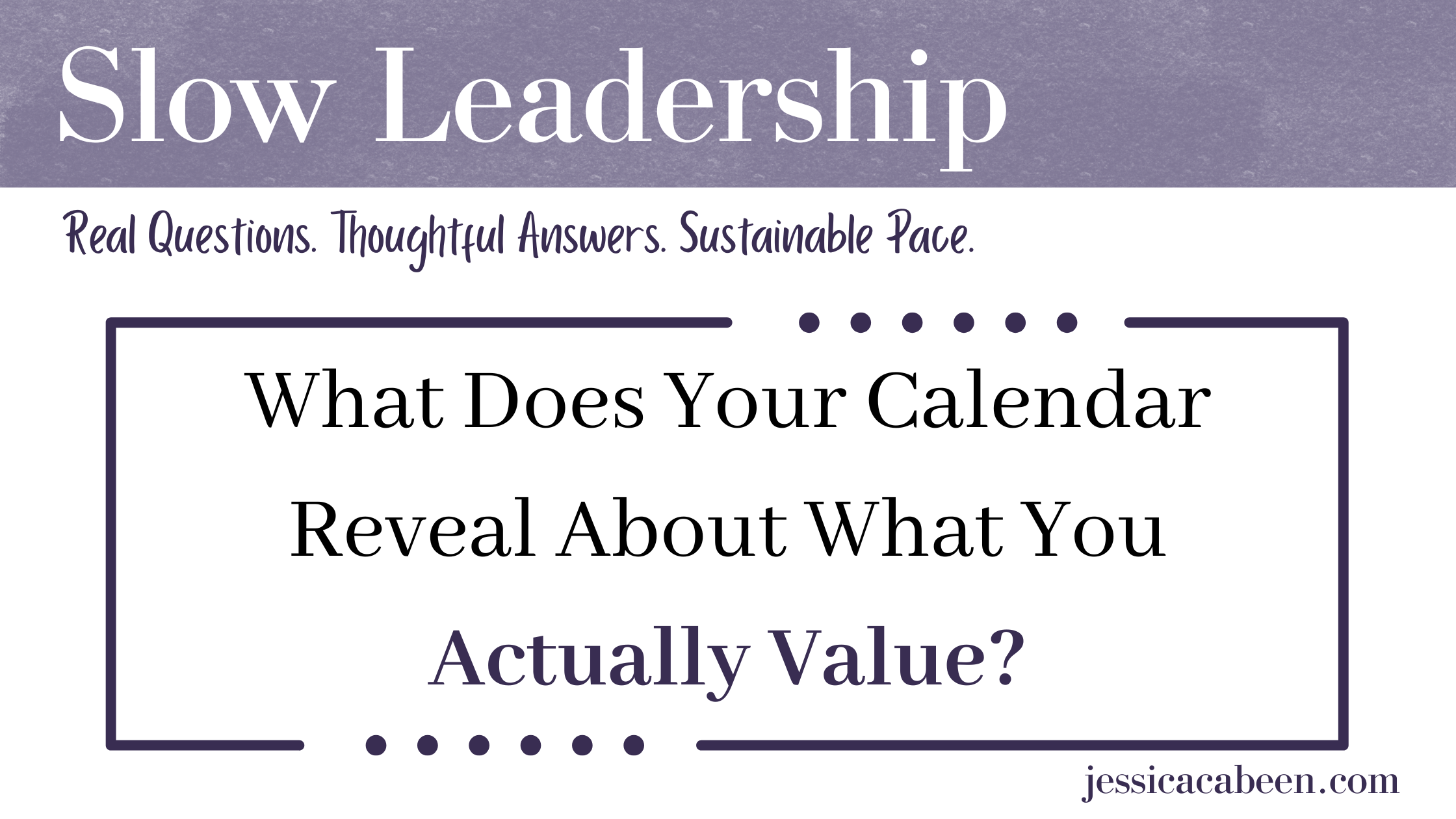
What does your calendar reveal about what you actually value?
And if your calendar could talk… it might tell a slightly different story.
Because calendars don’t lie.
They tell the truth about attention.
And attention reveals priorities.
Hustle culture hides behind good intentions.
Slow leadership audits behavior.
Stated Values vs. Scheduled Time
You might say:
“People matter most.”
But how much uninterrupted time do you spend with them?
“Strategy drives everything.”
But how much thinking time is actually protected?
“I want sustainable systems.”
But how much of your week is spent firefighting?
Your calendar isn’t just a schedule.
It’s a mirror.
Why Leaders Fill Every Space
In school leadership, empty space feels irresponsible.
So we fill it.
Meeting after meeting.
Conversation after conversation.
Issue after issue.
And somehow… you’re still double-booked at least once.
And the one thing you actually needed time for?
Didn’t make the calendar.
A full schedule doesn’t always signal importance.
It often signals discomfort.
Discomfort with slowing down.
Discomfort with not being needed in every space.
Discomfort with leaving problems unresolved—at least for now.
So we stay busy.
Because busy feels productive.
Busy feels visible.
Busy feels like leadership.
But it isn’t always aligned.
The Cost of a Full Calendar
If every minute is spoken for, there is no room to think.
And if there is no room to think, there is no room to lead.
Without reflection, there is no refinement.
Without refinement, there is no sustainable improvement.
Over time, your schedule doesn’t just reflect your leadership.
It shapes it.
Time Is a Strategic Resource
You budget money carefully.
You allocate staff intentionally.
But time—your most limited leadership resource—gets surrendered to urgency.
Hustle culture measures productivity by how full your day is.
Slow leadership measures effectiveness by how aligned your day is.
Alignment isn’t about doing less.
It’s about making better decisions.
Small shifts in time allocation compound into cultural clarity.
The Truth Most Leaders Avoid
You don’t just manage your calendar.
Your calendar is quietly managing you.
You can care deeply about culture
and still schedule against it.
You can value strategy
and never protect time to think.
And over time, what gets scheduled
becomes what gets sustained.
One Strategic Shift This Week
Audit one week of your calendar.
(And be honest—don’t skip over the parts you’d rather not look at.)
Circle:
• Time spent on top priorities
• Time spent reacting
• Time spent developing others
Then ask:
If someone studied this week, what would they say I value most?
Adjust one block.
Protect one hour.
Cancel one meeting.
Not to do less. To lead better.
Hustle culture fills time.
Slow leadership guards it.
And what you guard grows.
Slow Leadership Is a Practice — Not a Post.
If this resonated with you, you don’t need more noise. You need steadiness.
If you’re ready to go deeper:
→ Principal in Balance
Practical strategies for leading well at work and living well beyond it.
→ Bring This Conversation to Your Team
Keynotes and workshops that challenge hustle culture and build sustainable leadership systems.
→ Leadership Coaching
For leaders ready to move from impressive to sustainable.
Have a Leadership Question?
The real work of leadership isn’t tidy. If you’re carrying something — a tension, a doubt, a hard decision — you can ask here.
Big or small. Named or anonymous.
I won’t pretend to have all the answers. But I will meet you with clarity, practical thinking, and steady reflection.
Submit your question here: Question for Dr. Cabeen
0 Comments